
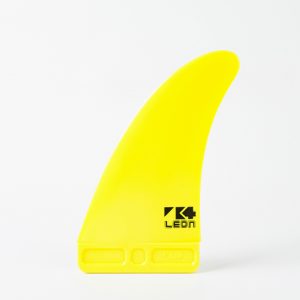
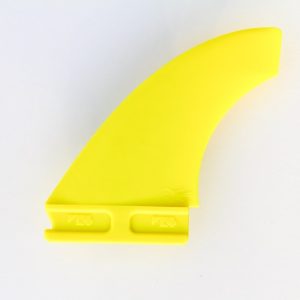


As with many things in windsurfing, fin tuning ultimately comes down to your own personal preference, your board and the conditions you sail in. There is NO one right set up. With that in mind, here are our guidelines and some general rules..
We recommend that when first using Dynamic Flex K4 Fins you place the rear fins slightly further back in the board than your old fins. They have more flex, so with the looser ride and extra maneuvrability you can afford to place them further back for more drive and hold.
SIZE SELECTION
As virtually everybody has used g10 fins in the past, the simplest size guide is to compare K4 Fins with a similer template g10 fin.
For an average weight sailor (75kg, 165lb, 12 stone), the fin size used would be the same. K4 Fins ‘Dynamic Flex’ will provide slightly less bottom end drive for early planing, but provide more grip and drive in turns due to their flex properties. They are much lighter and will also feel looser for a given size and more controllable in windy/choppy conditions. K4 Fins ‘Super Stiff’ material feels very similar to g10 but has better reflex and better damping through chop.
SAILOR WEIGHT
The lighter you are and the more fins your board has the more flex your fins should have. If we imagine both ends of the scale; a 55kg sailor sailing on a large quad board in good waves with a 4.5m sail in light winds, and a 95kg sailor sailing a 6m sail overpowered in chop on a small single fin board (or rear biased Tri fin), the difference in fin force is huge. The lighter sailor will need very flexible fins in order to get the most from his board and the heavy weight stiff fins to deal with the high loads (they will still want to twist). The more fins you have in your board the more the load is shared and the less force on each individual fin. Obviously the higher the load on a fin and the longer the fin, the more it will flex.
It’s a common myth that stiff fins are faster. The reverse is actually true -if you’re nicely powered up for wave or freeride sailing the softer material will be quickest off the wind. Speed fins are stiff purely to cope with the loads involved and prevent unwanted vertical lift from the fin bending.
We recommend that anyone wanting to get the ultimate wave performance from their board chooses the DYNAMIC FLEX material.
Our SUPER STIFF material is a lot more rigid, suits bigger fins, bigger riders and more straight-line performance.
TRI FINS
We’ve found that the highest performing tri fin set up is that of a long Flex fin of around say 17cm combined with front asymmetric Ezzy fins around 10cm with 3º of toe in per side. This gives excellent drive, grip, hold and maneuvrability. You can change your path mid bottom turn with ease, tightening the carve if needed to hit the lip more vertically and hit the lip with complete confidence knowing that the fins will hold and project. The deeper rear fin will eat any chop on the face you may have to deal with.
With a more equal sized thruster fin set up you are best with symmetrical side fins and stiffer templates such as the Stubby model (eg. 12 front 14 rear, or even all 13’s). This arrangement can give a lot of control and work well in windy onshore conditions. The shorter depth of rear fin will make tail slides easier off the top turn. You’ll need to choose a board with some toe in on the front boxes to work well with the large fronts.
QUAD FINS
With Quad fin set ups you can tune your board more ‘twin’ like with smaller fronts and larger rears (eg 6 or 8 fronts and 15 rear), as a standard quad (eg 10 front and 14 rear) or even go with equal fronts and rears (13s all round).
A rear area bias will make your board feel looser, faster, easier to redirect and have better ‘pivot’ in your top turn. It will be more ‘twin’ like in feel and we would recommend this set up for onshore conditions where looseness and snappy turns are the main requirement.
A standard quad set up will make the board feel drivier in the turns, much better for swooping cutbacks or power gouges. More grip and confidence in hollow or steep waves. The trade off is slightly less top speed and top turns may feel less snappy.
A front area bias will make the board easier to ‘push’ through turns and release the tail particularly when underpowered. You may find you lack speed and drive down the line with this set up though so it’s better suited to slow softer waves. You can get some nice ‘hooky’ top turns using the rail with this set up and can be good if you’re not having to chase the critical section.
FIN POSITION
The following is true for any fins and will help you get the best from your board..
Moving the fin cluster (1,2,3 or 4 fin) rearward will give your board more speed, more grip and more control. Better for big waves or big wind and perhaps for onshore conditions where drive and upwind are important.
Moving the fin cluster forward will make your board looser and skatier. Better for fun size waves and rippable conditions when nicely powered up.
Moving the fin cluster apart (tri and quads) will make the board feel more planted and stiffer. Better for large waves.
Moving the fin cluster together will make the board looser and with more pivot. Better for small waves.
FIN TEMPLATE
The outline of your fin makes a considerable difference to it’s performance..
A wider base will give better drive and acceleration.
A narrower base more speed and pivot.
A more upright fin with less ‘sweep’ will give tighter turns and more pivot.
A more swept back fin will give better control and more sweeping wide arc turns.
More area will give more hold but be stiffer for a given length.
Fins with a longer tip out the back (or rake) will give more grip and direction, better for larger arcs and powerful carves.
Fins with less tip will be more snappy and turn tighter, better for staying in the critical section of small waves. They may also be faster.
ASYMMETRIC FINS
For many years all surfboards have been supplied with asymmetric front fins, windsurfing has only just caught on, perhaps in some part due to the extra complication for manufacturers and customers (I’ll make this as painless as possible!).
By creating an asymmetric foil you can increase the amount of lift generated whilst keeping the drag low, the same as an aircraft wing. Asymmetric foils are more efficient at creating lift. This means more drive, power, hold and grip when your board is turning without a drag penalty.
Where things become complicated, is that an asymmetric foil will create lift when running ‘straight’, ie. it will pull to one side. This ‘pull’ is undesired for several reasons, but mostly that it is causing drag. In order to prevent this we turn the fin in towards the nose of the board until the fin neither pulls one way nor the other. This angle is the ‘toe in’. Of course the amount of ‘toe in’ for no lift (least drag) in a straight line varies depending on board design and how fast you’re travelling!
RECOMMENDED TOE IN ANGLE
Most boards with asymmetric front fins will perform best when the toe angle is between 2 and 3 degrees. For a thruster a toe angle of around 3º per side feels best. On a quad it becomes a little more complicated as the front and rear fins can be quite close together and need to run at similar angles. Therefore if the rear fins are straight a front angle of around 2-2.5º is best. The k4s come with a choice of +1, +2 or +3 degrees added toe. Therefore a tri fin board which has straight front boxes (zero toe) will need the +3º Ezzy fins, and a board with 1 degree will need the +2º.
Symmetric fronts can also benefit from toe in as brands such as Simmer, Fanatic and Naish have discovered. PRODUCTION BOARD TOE ANGLES.
TUNING WITH TOE ANGLE
You can also tune your board with toe in to some degree; small wave surfboards can have over 3 degrees toe, this is to make turns easier and sharper and can do this as the top speed is less important. Big wave surfboards have less toe for more drive, higher speeds and wider turns. You still need to stay within a reasonable range of toe though, so as not to cause unnecessary drag.
If you want to test the importance of toe in, then we’d recommend setting up a ‘straight boxed’ wave board up with very large fronts(14cm) and similar sized rears. This will highlight the faults of straight boxes far more than the standard very rear biased set ups which most production boards are supplied with.
You can learn more about toe angles and how to measure them in this BLOG POST.
We’ve produced an easy way for you to calculate your boards box toe in HERE.
FIN CARE
To keep your K4fins looking clean and shiny it does them no harm at all to go in the dish washer every now and then. This is highly recommended.
Minor nicks and scrapes can be easily sanded out with 240 or 400 wet and dry.
Major damage can be trimmed or scraped smooth with a sharp knife.